 EN

How to Choose Drum Brake Shoes for Hyundai and Nissan Applications
For a distributor, getting a drum brake shoe order right starts before the quotation. A code such as 819700pc is useful for searching, but it is not a substitute for confirming vehicle application, axle position, dimensions, and the exact cross-reference required by the buyer. That distinction matters when Hyundai and Nissan catalogues contain similar-looking rear brake shoes across different years, markets, and brake-system configurations.
This guide gives purchasing teams a practical way to evaluate 819700pc and related rear brake shoes. It is written for wholesalers, private-label brands, and parts distributors who need a repeatable fitment-check process rather than an assumption based on a picture or a short interchange list.
Start with 819700pc as a cross-reference, not a fitment guarantee
The first question is what 819700pc represents in the buyer’s own catalogue. A supplier number can be a useful search key, while an OE number or an aftermarket interchange can narrow the application. None of these identifiers alone confirms that the part will fit every Hyundai or Nissan vehicle carrying a familiar model name.
For example, the confirmed SDCX product record groups 819700pc with K1170, S575, BS1634, BS1656, FN1170, and OE reference 44060-98E25. Its listed applications include Hyundai Sonata and Nissan Bluebird, Prairie, and Sunny. Treat this as a starting point for an application review: model names can cover multiple generations, regional specifications, and brake layouts.
Ask the customer to provide the vehicle make, model, model year, market, engine or chassis identifier where available, and rear-axle brake configuration. Then compare those details with the customer’s catalogue, OE data, or a physical sample. This approach reduces the chance that a valid-looking 819700pc reference is applied to the wrong vehicle variant.
Confirm the rear axle and brake-system position
Drum shoes are commonly discussed as rear brake shoes, but “rear” is only the beginning of a fitment description. Before quoting 819700pc, confirm that the vehicle actually uses a rear drum arrangement for the relevant production period. Some trim levels or regional versions may use a different system, while service parts may vary with the backing plate, wheel cylinder, adjuster, or parking-brake hardware.
Request photographs of the removed set when possible. A clear image of the friction surface, shoe ends, lever locations, anchor points, and hardware orientation can reveal differences that a vehicle name does not. For rear brake shoes, establish whether the order is for one axle set and whether related springs, adjusters, or cylinders are required separately. Do not infer those items from 819700pc alone.
Match physical dimensions before approving 819700pc
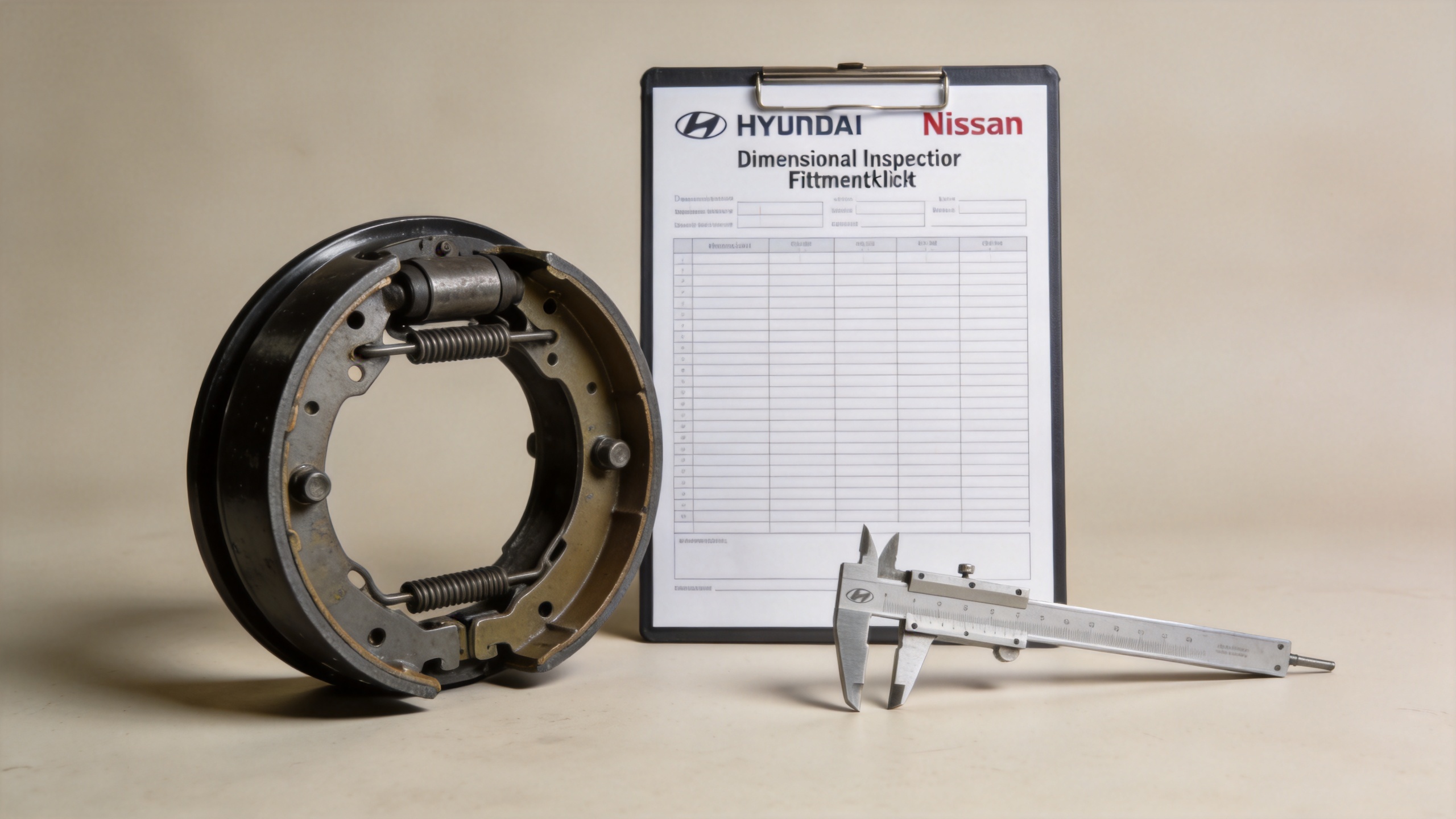
Part-number matching should be checked against a physical specification. Measure or confirm the brake-drum internal diameter, shoe width, arc profile, lining thickness convention, and the geometry of each shoe. Also verify the locations of holes, tabs, parking-brake levers, and wheel-cylinder contact points. Two sets of rear brake shoes can appear close in an image yet differ at an interface that prevents safe installation.
| What to confirm | Why it matters | What to request |
|---|---|---|
| Drum diameter and shoe width | They determine the basic working envelope. | Measured sample or approved drawing. |
| Shoe profile and end geometry | They affect contact with the backing plate and cylinder. | Front, rear, and side photos of both shoes. |
| Lever and adjuster locations | They distinguish left/right or primary/secondary arrangements. | Hardware layout photo and application notes. |
| Reference numbers | They support catalogue comparison. | OE number, aftermarket number, and buyer’s internal code. |
Use this table when reviewing 819700pc. If one critical measurement is missing, mark the quotation as pending confirmation rather than presenting 819700pc as an unconditional match.
Use the confirmed product record carefully
When the buyer’s requested application aligns with the available cross-references and sample review, the confirmed product record can support the discussion. The product is listed as SDCX Drum Brake Shoe K1170 S575 BS1634 BS1656 FN1170 44060-98E25 for Hyundai Sonata and Nissan Bluebird, Prairie, and Sunny. The page title supplies cross-reference and named-application information; it should not be read as proof of fitment for every year or variant.
A sound sourcing workflow is to map the customer’s specification to 819700pc, compare the supplied OE or interchange references, review the sample, and document the final approved application. For a new private-label program, retain the buyer-approved sample and label information with the purchase order. That creates a useful record if a future order uses the same 819700pc reference but a different target market.
Build a quotation and sample checklist
At the consideration stage, buyers need a comparison process that makes exceptions visible. Include the following fields in every 819700pc enquiry:
- Vehicle make, model, year range, market, and relevant chassis information.
- OE number and all buyer-supplied interchange numbers.
- Confirmation that the request is for rear brake shoes and the intended axle set quantity.
- Brake-drum diameter, shoe width, and photographs or drawings when available.
- Required packaging, branding, barcode, and sample-approval requirements.
- Whether hardware is included, excluded, or quoted as a separate line.
This checklist turns 819700pc from a search term into a documented sourcing decision. It also gives the supplier a clear basis for identifying mismatches before production or shipment.
Common mistakes when selecting rear brake shoes
The most frequent mistake is choosing rear brake shoes from a model name alone. A second is treating a cross-reference as identical across all regions and years. A third is approving 819700pc without confirming the physical sample or key dimensions. These shortcuts may save time at the enquiry stage, but they create avoidable returns, delayed installations, and catalogue corrections later.
A better practice is to document what has been verified and what still needs confirmation. If the OE number, dimensions, or hardware arrangement has not been checked, say so in the quotation. Clear limits protect both the distributor and the end customer while keeping the fitment review moving forward.
Final selection advice
Choose Hyundai and Nissan rear brake shoes by combining application data with part-number and physical checks. Use 819700pc, K1170, S575, BS1634, BS1656, FN1170, and 44060-98E25 as cross-reference inputs, then verify the vehicle variant, rear brake configuration, dimensions, and sample. For recurring programs, save the approved application record so the same 819700pc request can be reviewed consistently on later orders.
For an enquiry involving the listed Hyundai Sonata or Nissan Bluebird, Prairie, or Sunny references, share the OE number, vehicle details, and sample requirements first. That gives the sourcing team the information needed to evaluate the requested 819700pc application responsibly.