 EN

Carbon Ceramic Brake Pads: When Should Distributors Consider This Product Line?
For a distributor, adding carbon ceramic brake pads is not chiefly about whether the material sounds premium. The decision depends on fit with the local vehicle parc, the customers your sales team serves, the brake hardware already on those vehicles, and the technical support your channel can provide. In practice, the right time to consider the line is when several of those signals appear together—not when a single buyer asks for a high-performance part.
There is also a terminology issue worth settling early. In the market, “carbon ceramic” may refer to carbon fiber ceramic brake pads, to vehicles fitted with carbon-ceramic brake rotors, or to both. Those are related conversations, but they are not interchangeable. A distributor that clarifies the application before quoting is in a stronger position to avoid an unsuitable recommendation.
Start with a demand signal, not a catalog gap
Carbon ceramic brake pads are most worth considering when demand is repeatable and identifiable. Look for inquiries from performance workshops, specialist retailers, premium vehicle service networks, or customers managing models with higher brake-temperature exposure. A few isolated requests can justify research and samples, but they rarely justify a broad inventory commitment.
Ask sales teams to record why the customer is asking. Is the request tied to a specific vehicle application? Are buyers seeking a particular noise, dust, or pedal-feel characteristic? Do they need pads that work with an existing carbon-ceramic rotor system? These answers help separate a genuine product-line opportunity from a loosely defined request for “better brakes.”
For decision-stage distribution planning, the useful threshold is a pattern of inquiries that can be grouped by vehicle platform, customer type, and order potential. That gives the purchasing team a defensible way to set an initial SKU scope instead of importing unrelated part numbers because a premium label seems attractive.
Verify exactly what the product must be compatible with
The phrase carbon ceramic brake pads should not replace a vehicle-level compatibility check. The pad shape, backing plate, caliper design, rotor material, friction characteristics, hardware, and OE or aftermarket reference all matter. If a buyer means a pad for a vehicle equipped with carbon-ceramic rotors, confirm that requirement explicitly. If the buyer means a carbon-fiber-enhanced ceramic friction formulation for a conventional disc system, confirm that instead.
This distinction changes the sales conversation. A carbon-fiber ceramic brake pad may be positioned as a friction-material option for a defined application, while a pad intended for a carbon-ceramic rotor system requires careful review of the vehicle specification and supplier documentation. Neither route supports a blanket promise about stopping performance, noise, dust, or service life.
Before an SKU is approved, collect the application list, OE cross-references, dimensions, backing-plate details, installation notes, recommended rotor pairing, and any limits on use. The distributor should also decide how the sales team will handle incomplete fitment information. “Please confirm the vehicle, caliper, rotor type, and OE reference” is a safer and more useful response than guessing from a model name alone.
Use technical documentation as a line-entry gate
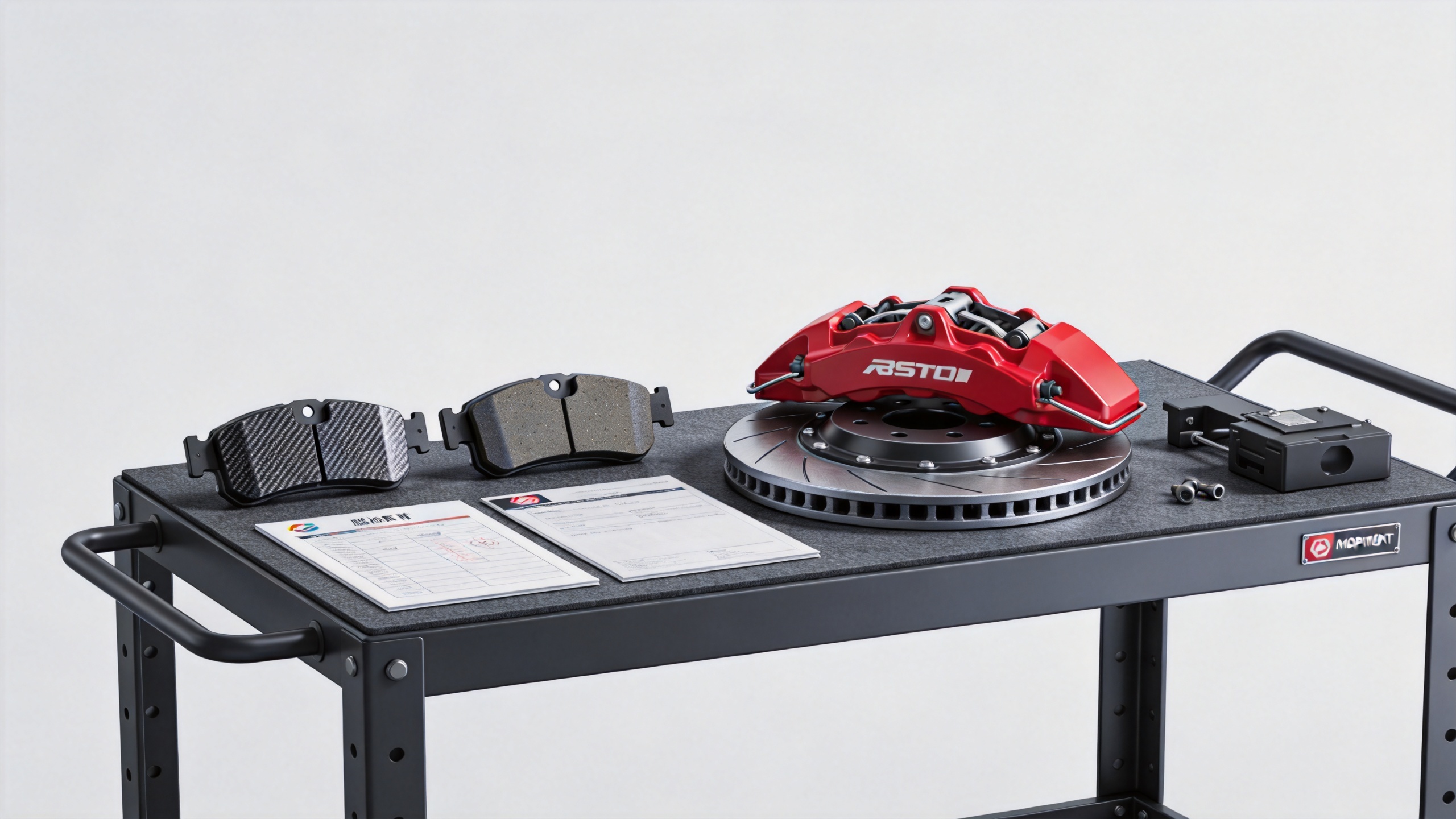
Technical paperwork does not replace your own validation, but it makes a new line easier to evaluate. For example, SAE J840 covers test procedures for shear strength of automotive brake pads and brake lining assemblies. A distributor can use that as one reference point when requesting information about friction-material attachment to the backing plate. It should not be presented as proof that a complete vehicle system meets every road-performance requirement.
The same boundary matters for vehicle regulations. FMVSS No. 135 addresses light-vehicle service and parking brake systems at the vehicle level. A pad alone cannot reasonably be represented as making a vehicle compliant. That is why product training should distinguish component documentation from system-level claims and make clear when the vehicle manufacturer’s specification controls the decision.
For a first order, request documentation that is specific to the proposed part number and application. Review how test information is described, whether the application references are current, and what the supplier can provide if the channel receives a fitment or performance question after sale.
Run a controlled sample program before building depth
A staged launch gives distributors more useful information than a large opening order. Select a limited set of carbon ceramic brake pads for the applications that generated the strongest, clearest inquiries. Then establish a sample-review process with defined checks: packaging and labeling, fitment against the approved vehicle list, installation feedback from qualified technicians, and the completeness of supporting documents.
Keep the feedback form practical. It should capture the exact application, rotor type, installation conditions, mileage or duty context where available, and the nature of any concern. Do not turn a small sample program into a universal performance claim. Its purpose is to confirm whether the catalog data, channel support, and customer expectations align well enough for a wider release.
When discussing other ceramic options with buyers, a proven catalog item can help frame the conversation without implying that it is an equivalent substitute. For example, the CX-D1210 no noise premium ceramic brake pad is a confirmed catalog reference for a defined passenger-car application. Its listing should be evaluated on its own application data; it does not establish compatibility for every carbon ceramic brake pad request.
Check whether your operations can support a premium, narrower line
Product fit is only half of the decision. A distributor should consider carbon ceramic brake pads when operations can support a narrower SKU range with clearer pre-sale questions, controlled replenishment, and a documented returns process. Premium or specialist applications may turn more slowly than mainstream pads, so inventory planning should start with demand evidence instead of broad assortment logic.
Sales and customer-service teams also need an escalation path. They should know when to request a VIN or OE number, when to ask about rotor material, and when not to make a performance comparison. The goal is not to make every conversation technical; it is to ensure that the channel gathers the minimum information needed for a responsible recommendation.
- Inventory: begin with applications supported by repeat inquiries and verified catalog coverage.
- Sales enablement: provide a short terminology guide for carbon-fiber ceramic formulations versus carbon-ceramic rotor applications.
- Quality review: retain part-specific fitment and documentation records for the samples and initial batches.
- After-sales: define what information is required before a compatibility or return decision is made.
A practical go/no-go checklist for distributors
Consider introducing carbon ceramic brake pads when the answer is “yes” to most of these questions:
- Can we identify recurring demand by vehicle platform or customer segment?
- Do we know whether the request concerns carbon-fiber ceramic brake pads, carbon-ceramic rotor compatibility, or both?
- Can the supplier provide part-specific fitment, dimensions, and supporting technical documentation?
- Can we validate a small sample group before expanding the assortment?
- Can our team collect the vehicle and brake-system details needed to reduce the chance of misapplication?
- Can we carry the initial range without treating it like a high-volume mainstream line?
If several answers remain unclear, the better next step is to collect applications and sample information—not to make sweeping product claims. If the demand, documentation, compatibility process, and channel support are in place, carbon ceramic brake pads can become a deliberate extension of a high-performance brake-parts offer rather than a speculative catalog addition.