 EN

Ceramic Disc Brake Pads: Questions to Ask a Supplier
When a buyer searches for a ceramic disc brake product, the first task is to make the terminology precise. A ceramic-friction brake pad is not the same product as a carbon-ceramic brake disc. The former is a replacement friction component; the latter is a high-performance rotor system. Mixing the two can distort price comparisons, test requirements, and vehicle-fitment decisions before a quotation is even reviewed.
For brake pad brand owners, distributors, and wholesalers, a productive supplier conversation is less about asking whether a pad is “good” and more about requesting evidence that the proposed part matches a defined vehicle application, market, and approval process. The questions below turn a general ceramic disc brake inquiry into a documented sourcing decision.
Start with the application—not the material label
A ceramic disc brake pad formula may be suitable for one passenger-car application and unsuitable for another. Before discussing friction material, give the supplier a clear application brief: vehicle make, model, year range, axle position, OE or aftermarket reference, engine or brake-system variant where relevant, target market, expected sales channel, and estimated annual volume.
Ask: Which exact part number and fitment references does your quotation cover, and what source supports that fitment? A useful response should connect the pad shape, backing plate, hardware, and vehicle application rather than simply list a broad brand name. It is also sensible to ask whether the supplier treats left/right, front/rear, and sensor or shim variants as separate configurations.
There is a practical reason to do this first. A material discussion cannot compensate for an unclear application. If the buyer has not defined the vehicle, rotor condition, intended market, and target positioning, two ceramic disc brake quotes may look comparable while referring to different product configurations.
Ask what “ceramic” means in this quoted formula
“Ceramic” is a market term used differently across product lines. It should not be treated as a complete material specification. Ask the supplier to explain the formula category in commercial terms and to identify the intended balance among low dust, noise behavior, rotor interaction, pedal feel, wear, and cost. The purpose is not to request proprietary formula percentages; it is to establish a clear, testable performance target.
- What is the stated application position for this ceramic disc brake pad: daily passenger-car replacement, premium aftermarket, fleet service, or another segment?
- Which performance attributes are being targeted, and which trade-offs should a buyer expect?
- Is the quoted material the same for every application, or does the formula change by part number, vehicle mass, axle, or market?
- What companion parts—shims, chamfers, slots, clips, or sensors—are included in the supplied configuration?
A supplier that can explain its boundaries is usually more useful than one that promises every outcome at once. Low noise, low dust, thermal stability, and service life are all relevant questions, but their priority should follow the vehicle and channel brief.
Request test evidence with its conditions and scope
Do not ask only, “Do you have test reports?” Ask which part number, configuration, and test conditions the report represents. Performance evidence for a ceramic disc brake quotation should be traceable to the offered application or clearly identified as a related reference sample.
For example, SAE J2522—often called the AK Master test—is a dynamometer procedure used to simulate a range of braking scenarios. If a supplier cites this or another procedure, ask for the test method name, laboratory or test facility, sample identification, rotor and system configuration, relevant temperature or pressure conditions, date, and the part number covered. A report without that context may be useful background, but it is not automatically proof for every quoted pad.
For Europe-bound replacement parts, ask whether ECE R90 applies to the proposed part number and market. Where the supplier presents ECE R90 documentation, confirm the certificate scope, the part-number coverage, the marking requirements, and whether the document relates to the final supplied configuration. Market requirements vary, so this is a documentation check—not a claim that one approval fits every destination.
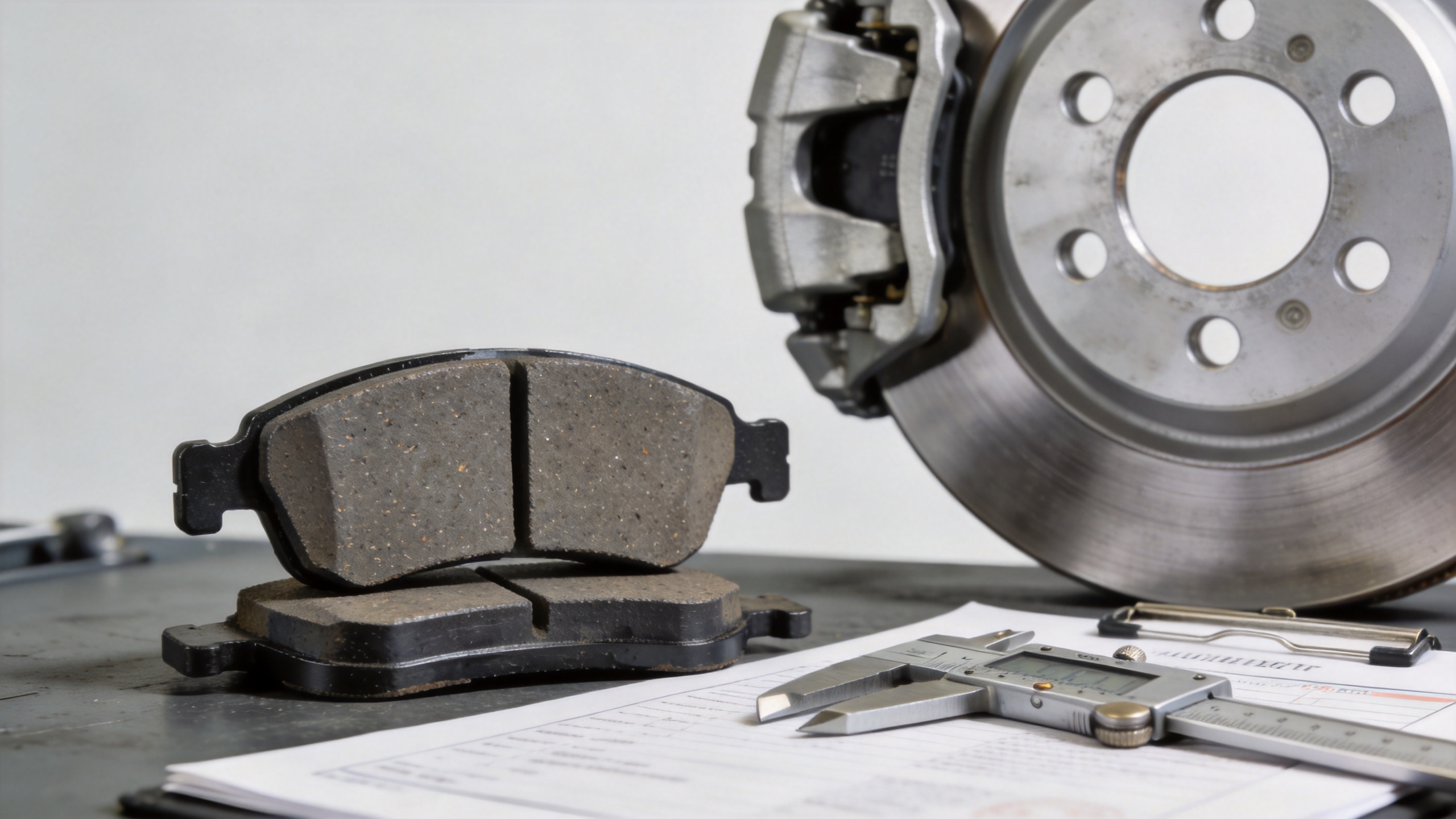
Confirm the comparison baseline and acceptance criteria
A purchase order should not rely on an undefined phrase such as “OE quality.” Ask the supplier and your internal team to define the benchmark. Is the comparison against an OE reference, an approved control sample, a previously supplied batch, or a target specification? Then document which observations or tests will be used for approval.
| Question to ask | Why it matters | Evidence to request |
|---|---|---|
| Which reference part is the comparison baseline? | Prevents different teams from approving different expectations. | Reference number, sample identification, and application list. |
| What are the acceptance criteria for fitment and appearance? | Controls backing-plate shape, hardware, marking, and packaging details. | Approved drawing, photo standard, or signed sample record. |
| How will friction and noise concerns be evaluated? | Moves vague performance language into an agreed verification plan. | Test method, operating conditions, and review process. |
| What happens if a production lot differs from the approved sample? | Clarifies containment, review, and corrective-action expectations. | Nonconformance and lot-traceability procedure. |
Check manufacturing control and lot traceability
For repeat purchasing, the approval sample is only the start. Ask how the supplier links incoming materials, pressing or curing operations, inspection records, and finished cartons to a production lot. You do not need to dictate a factory’s internal process; you do need enough information to trace a delivered ceramic disc brake batch if a fitment, noise, or packaging issue is reported later.
Useful questions include: What lot number appears on the product or carton? Can the supplier identify the production date and inspection record from that number? Are retention samples kept? What is the process for a complaint that affects one market or one delivery? How are design, compound, supplier, or tooling changes communicated before shipment?
These are especially important for distributors managing several markets. A clear change-notification rule makes it easier to protect catalog accuracy and avoid mixing a new configuration with a previously approved one.
Review samples, packaging, and private-label readiness
Before placing a volume order, align the commercial sample with the finished deliverable. Ask whether the sample uses the same material family, hardware, surface treatment, marking method, and packaging configuration planned for production. If branding is required, confirm artwork ownership, carton dimensions, labels, barcode placement, language requirements, and any minimum order quantity tied to private-label packaging.
For a relevant application example, buyers can review the available product record for ceramic disc brake pads for Mercedes-Benz applications alongside their own OE references and approval criteria. The listing is a starting point for fitment discussion, not a substitute for application-specific verification.
Also ask for a pre-shipment checklist. It should cover part number, quantity, carton and inner-box artwork, visible markings, hardware inclusion, and the documents that will accompany the shipment. This step prevents a technically acceptable pad from arriving in a commercially unusable package.
Turn answers into a supplier-approval record
A strong ceramic disc brake sourcing process ends with one reusable record, not a scattered email thread. Capture the supplier’s quotation, fitment cross-reference, formula positioning, test-document list, sample outcome, packaging specification, delivery terms, change-control commitment, and open questions. Assign an owner and due date to every unresolved item.
The most useful decision rule is simple: approve only what has been defined and verified for the target application. If a supplier’s answer is conditional, record the condition. If a test report covers a different part, label it as supporting background rather than direct approval evidence. That discipline helps brand owners and distributors compare suppliers on evidence, not on the broadest claim.
Final supplier question checklist
- Which vehicle applications and part numbers does this quote cover?
- How does the supplier define the proposed ceramic disc brake material and intended market position?
- Which included hardware, shims, markings, and variants are part of the price?
- What test methods and reports relate directly to the quoted configuration?
- Which approvals or market documents apply, and what is their part-number scope?
- What reference sample and acceptance criteria will govern approval?
- How are lots identified, retained, and traced after shipment?
- How will formula, tooling, component, or packaging changes be communicated?
- Does the sample match the planned production material and packaging?
- What must be checked before shipment for private-label and market readiness?
By asking these questions early, buyers can make a ceramic disc brake decision that is technically clearer, commercially easier to manage, and more repeatable across future purchase orders.