 EN

Brake Pad Material Types Explained for Wholesale Parts Selection
For a parts wholesaler, brake pad material types are not simply product labels. They affect how you segment a catalog, answer distributor questions, manage returns, and match a replacement pad to a vehicle’s expected duty cycle. A material name also does not tell the whole story: friction formulation, backing plate design, shim system, slotting, fitment, and supplier validation all contribute to the finished part.
This guide is written for buyers building or refining passenger-car brake pad ranges. It explains the common terms customers use, then turns them into a practical selection method for catalog planning and customer recommendations.
Start with the right definition of brake pad material types
The friction block on a disc brake pad is a composite. It may combine fibers, fillers, lubricants, abrasives, binders, and metallic ingredients. Therefore, terms such as ceramic, semi-metallic, organic/NAO, and low-metallic describe a formulation family—not a universal promise about stopping distance, noise, or service life.
In wholesale conversations, separate three questions:
- What is the friction-material family? This guides the expected balance of heat handling, noise, dust, and rotor interaction.
- What is the intended vehicle application? Weight, brake system design, driving pattern, and regional road conditions matter.
- What evidence supports the part? Confirm fitment, marking, validation records, and the supplier’s consistent manufacturing controls.
That distinction prevents a common catalog error: treating every ceramic pad as premium for every application, or treating every semi-metallic pad as the same product.
Ceramic brake pads: a quiet, clean-oriented catalog option
Ceramic friction materials generally use ceramic fibers or particles with other bonding and friction ingredients. In passenger-car aftermarket ranges, buyers often consider them when the target customer places high value on low visible dust, refined braking feel, and noise control. They can be a sensible category for modern commuter vehicles and customers who expect a more comfort-oriented replacement experience.
However, ceramic is not a substitute for fitment validation. A catalog should still confirm the pad shape, hardware package, brake-system compatibility, and the intended operating temperature range. When a customer asks about semi metallic vs ceramic brake pads, explain the application first rather than presenting ceramic as automatically better.
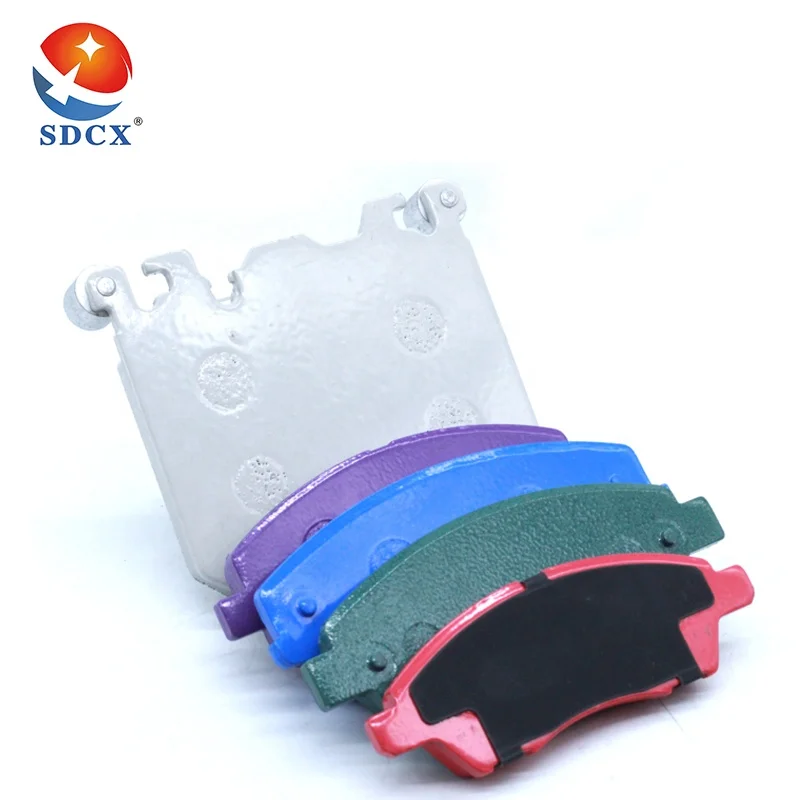
For example, a verified product listing for ceramic disc brake pads for Mercedes-Benz applications can be reviewed as a fitment-specific option. The product title identifies the material family and vehicle application; buyers should still request the relevant drawings, fitment confirmation, and validation documentation before adding it to a range.
Semi-metallic brake pads: a heat-tolerant, broad-use family
Semi-metallic pads blend metal content with non-metallic friction ingredients. Search evidence commonly describes their metal content as roughly 30% to 70%, but the exact formulation varies by manufacturer and part number. Steel, iron, copper alternatives, or composite alloys may appear alongside resin, fibers, graphite, and other modifiers.
For a wholesaler comparing brake pads metallic vs semi metallic vs ceramic, semi-metallic options are often relevant for applications where stable performance under repeated braking and a familiar replacement profile are important. The trade-offs can include more visible dust, greater noise sensitivity in some applications, or different rotor interaction than a comfort-focused ceramic formulation.
A useful sales rule is to avoid selling the family name alone. Pair it with a duty description: urban stop-and-go, mixed highway use, fleet service, or heavier passenger-vehicle demand. Then verify that the supplier’s specified application and test information support that recommendation.
Organic and NAO brake pads: explain the term before recommending it
Organic or NAO (non-asbestos organic) pads generally use non-metallic fibers and resins. Depending on the formulation, ingredients can include rubber, carbon, glass, aramid-type fibers, and fillers. These pads are often discussed in the context of smooth engagement and lower noise potential, but their heat tolerance and wear behavior must be assessed against the exact application.
For catalog managers, “organic” should not be used as a vague economy label. Instead, document the intended vehicle class, expected service environment, and positioning relative to the corresponding semi-metallic or ceramic offer. This keeps product comparisons clear for distributors who need to build tiered product ranges without overclaiming performance.
Low-metallic and other labels: keep your filters precise
Low-metallic NAO is frequently treated as a separate catalog filter because it uses predominantly organic materials with a smaller metallic component. It may be positioned between fully non-metallic organic formulas and semi-metallic formulas, but there is no single percentage threshold that should be assumed across every supplier or market.
You may also encounter carbon-ceramic, sintered, heavy-duty, or performance-oriented descriptions. Do not place them in the same filter solely because the wording sounds similar. Confirm the target vehicle, brake-system architecture, compound specification, and intended use. A passenger-car replacement range should not inherit the language or expectations of racing, motorcycle, or commercial-vehicle pads.
A wholesale comparison matrix for material-family selection
| Material family | Typical buyer conversation | Potential strengths to assess | Key verification point |
|---|---|---|---|
| Ceramic | Comfort-oriented passenger-car replacement | Noise and dust expectations; refined daily driving positioning | Fitment, pad hardware, and application-specific validation |
| Semi-metallic | Broad-use or higher-demand replacement applications | Heat-management potential and familiar market positioning | Noise, dust, rotor interaction, and duty-cycle suitability |
| Organic / NAO | Application-specific comfort or value range | Smooth engagement and material-family differentiation | Operating conditions, wear behavior, and clear vehicle targeting |
| Low-metallic NAO | Intermediate catalog positioning | A distinct option between organic and semi-metallic labels | Supplier definition, material description, and consistent catalog use |
Use this matrix as a conversation starter, not as a performance ranking. The correct choice is the one that matches the vehicle application, customer expectation, and verified product evidence.
Build a safer catalog and recommendation process
- Filter first by fitment. Vehicle platform, brake-system dimensions, pad shape, and hardware requirements come before material preference.
- Use material family as the second filter. Present ceramic, semi-metallic, organic/NAO, or low-metallic choices only where the supplier confirms the application.
- Ask for traceable evidence. Request drawings, part-number cross references, friction-material markings, and applicable test or quality records. SAE J866-style friction identification can support an incoming-quality discussion, but it should not replace application validation.
- Define the customer’s priority. Is the buyer reducing noise complaints, seeking a broad replacement range, managing dust expectations, or covering a particular vehicle segment?
- Control claims in product copy. Avoid universal statements such as “maximum stopping power” or “zero noise.” Describe the intended application and the confirmation process instead.
Conclusion: material labels are a starting point, not the buying decision
Understanding brake pad material types helps a wholesaler organize a practical range and have clearer conversations with distributors. Ceramic, semi-metallic, organic/NAO, and low-metallic labels give a useful first layer of comparison. The more reliable buying decision comes from combining that label with verified fitment, duty cycle, friction-material identification, and supplier documentation.
For passenger-car brake pad sourcing, build material filters that help customers compare choices—but keep the final recommendation rooted in the specific vehicle and the evidence available for that part number.